Massive  (Hot Dark Matter) continued
Last time we started talking about (1) and (2) below:
- Lab upper bounds on
 .
- Neutrino oscillations:
 :

Now suppose at time  we have a pure
 produced. Then:

At time t:

Where  , and
 , assuming a fixed momentum state. We assume this for simplicity, but a full wave-packet-based derivation is done in (Kayser (81) PRD 24,110). Anyway, the probability of finding a
 state at time t is:

For relativistic (we don’t really need to make this assumption, it just makes our lives easier), then:

Thus:
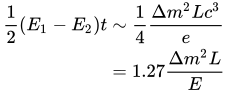
Where  is the distance travels in meters,
 is in
 , and
 is in MeV Thus we have our expression for the probability of an
 neutrino turning into a
 neutrino in a vacuum:

- Supernova : (SN1987A: Feb 23 1987) "(a)" Supernovae produce via:
 , which happens within the first (0.1 sec) of final star collapse (note that the n is what makes neutron stars. "(b)" They also produce via:
 , where
 . "(c)" Time for to travel from 1987A: If neutrinos are massless,
 ,
 . However if
 , then
 ,
 , so:


The difference in times of arrival for if neutrinos are massive or not is:


